
learn · transport · 03
Yamux
One encrypted connection between two devices carries many independent conversations at once. Yamux splits it into streams, and NomadFS opens one for every request.
What Yamux is
Yamux (“yet another multiplexer”) is a small protocol from HashiCorp that carries many logical streams over one ordered byte stream. libp2p uses it too. Each piece of data is sent as a frame with a 12-byte header that names its stream, so frames from different streams can be interleaved and sorted out at the other end.
Without it, two devices would need one TCP connection and one Noise handshake for each request in flight, or would have to wait for one request to finish before starting the next. With it, a large block transfer and a directory listing can share the connection without one waiting for the other.
Frames on the wire
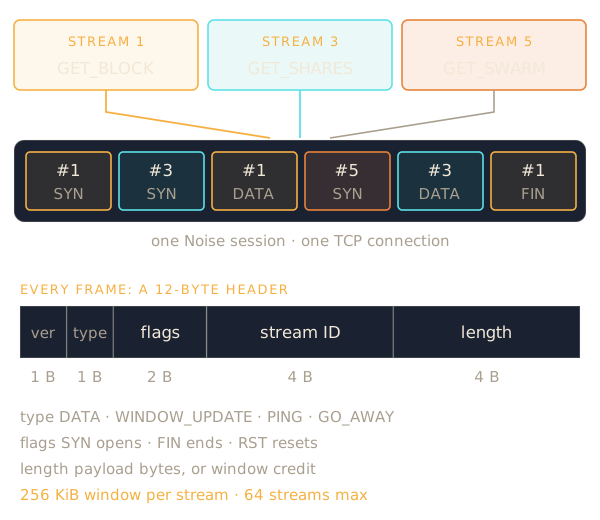
Every frame starts with the same header, integers big-endian:
| Field | Size | Meaning |
|---|---|---|
| version | 1 B | always 0 |
| type | 1 B | DATA, WINDOW_UPDATE, PING or GO_AWAY |
| flags | 2 B | SYN opens a stream, FIN ends one side, RST aborts, ACK marks a ping reply |
| stream ID | 4 B | which stream the frame belongs to |
| length | 4 B | bytes of payload after the header, or the window credit granted |
Yamux sits inside Noise: a Yamux frame is written to the Noise stream, which seals it in encrypted frames of at most 1024 bytes. The other side decrypts, reads the header, and appends the payload to the right stream’s buffer. Unknown versions or frame types are rejected.
Opening and closing streams
Both sides can open streams. To keep their IDs from colliding, the side that dialed the connection uses odd IDs (1, 3, 5, …) and the side that accepted it uses even IDs (2, 4, …). A stream opens with a DATA frame carrying SYN and no payload. The other side queues it until something accepts it.
Closing is per direction. FIN means “I won’t send more”, and the stream is freed once both sides have closed it. RST drops it at once. GO_AWAY asks the peer to open no new streams; streams already open keep working.
Flow control
Each stream has a receive window of 256 KiB: the most the sender may send before the receiver has read it. A writer that has used up the window waits. When the application reads from a stream, the receiver sends a WINDOW_UPDATE frame granting that many bytes back. A slow reader on one stream holds back only that stream’s sender.
A session allows at most 64 live streams. Together with the window, that limits the data a peer can make a device buffer for it to 16 MiB per connection.
How NomadFS uses streams
Every request gets its own stream: open, send one message, read one reply, close. A PING, a GET_BLOCK for one chunk, a GET_SHARES or a GET_SWARM each run on their own stream with their own timeout. On the receiving side, one thread accepts streams and hands each to a handler thread. A request that takes long, such as reading a megabyte from disk, doesn’t hold up the others.
Each connection also runs one reader thread that pulls frames off the Noise stream and sorts them into streams.
Source: src/net/transport/yamux.zig, src/net/transport/tcp.zig, src/net/discovery/node.zig.