
learn · transport · 02
Noise XXpsk3
Every NomadFS connection starts with a three-message Noise handshake. It encrypts the connection, checks that both sides hold the swarm key, and proves each device's identity.
What Noise is
The Noise Protocol Framework is a recipe for handshakes. It works without certificates or a certificate authority. A pattern says which keys each side sends and which Diffie-Hellman (DH) operations it mixes in. Every DH result goes into a running chaining key, and every message goes into a running handshake hash, so each step depends on everything before it. WireGuard and the Lightning Network use Noise too.
NomadFS uses one fixed suite, Noise_XXpsk3_25519_ChaChaPoly_BLAKE2s:
- XX: both sides send their static (long-lived) public key during the handshake, encrypted. Neither has to know the other’s key in advance.
- psk3: a 32-byte pre-shared key is mixed in at the end of message 3. In NomadFS that key is the swarm key.
- 25519: X25519 for the DH operations.
- ChaChaPoly: ChaCha20-Poly1305 encryption, which also authenticates.
- BLAKE2s: the hash used for the handshake hash and for key derivation (HKDF).
The handshake
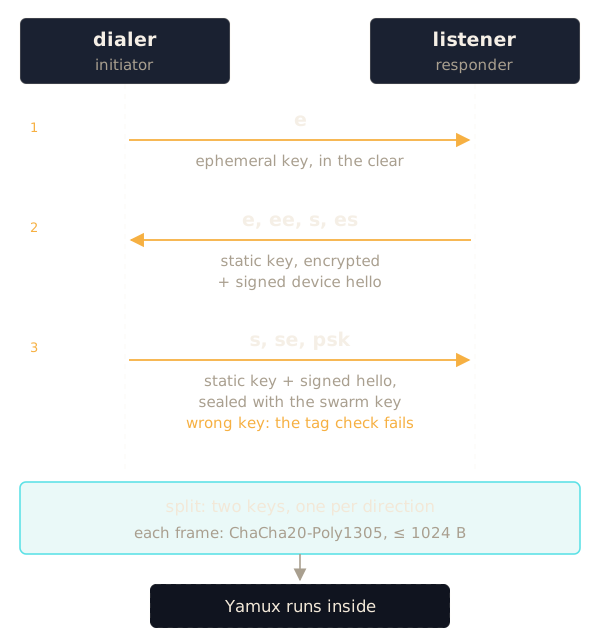
-> e. The dialer creates a fresh ephemeral X25519 key pair and sends the public half. It isn’t encrypted yet, but it goes into the handshake hash.<- e, ee, s, es. The listener sends its own ephemeral key. Both sides computeee(DH of the two ephemerals), which gives the first encryption key. The listener sends its static key encrypted under it, then both mix ines(dialer’s ephemeral with listener’s static).-> s, se, psk. The dialer sends its static key encrypted, both mix inse, and then the swarm key.
Each message is sent with a 2-byte length in front, and the whole handshake has 10 seconds to finish. After message 3 both sides derive two keys from the chaining key, one per direction. From then on every frame on the connection carries at most 1024 bytes of data, is encrypted with ChaCha20-Poly1305 and a counter nonce, and is checked on arrival.
Because each connection uses new ephemeral keys, someone who steals a device’s keys later can’t decrypt traffic they recorded earlier.
What the swarm key proves
The swarm key is mixed in just before message 3’s payload is encrypted. A dialer with a different key derives different encryption keys, so the listener’s tag check on that payload fails and the connection is closed. Only devices with the same swarm key complete a handshake, and the key itself never crosses the network.
The order matters in one way. The listener’s static key and device hello in message 2 are encrypted before the swarm key is mixed in. The dialer reads them, so it learns who the listener is before either side has proven it holds the swarm key. The dialer’s own device hello comes after the swarm key is mixed in, so the listener learns the dialer’s identity only once the swarm key checks out.
Binding the device identity
The X25519 key in the handshake is the transport key. The device’s lasting identity is a separate Ed25519 key (device.key), the key that pairing, the trust store and revocations refer to. NomadFS ties the two together inside the handshake.
Messages 2 and 3 each carry an encrypted device hello of 97 bytes:
version (1) ‖ Ed25519 public key (32) ‖ signature (64)
signature = Ed25519-sign("nomadfs-device-auth-v1" ‖ handshake hash)
The signature covers the handshake hash at that moment: both ephemeral keys, both static keys, and in message 3 the swarm key too. A hello captured from one connection is worthless in any other. The receiver verifies the signature, and the device ID is BLAKE2s-256 of the Ed25519 public key. Then:
- if the device is in the trust store, its pinned transport key must equal the static key in this handshake, so a stolen
node.keycan’t pose as the device; - with
require_trusted_devices = true, devices that aren’t in the trust store are refused outright. By default any holder of the swarm key may connect.
Invites: the same handshake, a different key
A one-time invite has to get the swarm key to a new device that doesn’t have it yet. It runs the same XXpsk3 handshake with a different pre-shared key:
nomadfs://invite?addr=192.168.1.20:9001&token=<32 hex characters>
psk = SHA-256("nomadfs-invite-v1:" ‖ token)
The inviting device opens a separate listener (on its node port + 1) that takes one join within 10 minutes. Both sides use throwaway transport keys and derive the PSK from the 128-bit token. Only someone holding the code can finish the handshake, and 128 random bits can’t be guessed offline the way a short PIN could. Inside that channel the two devices exchange signed pairing tickets (identity key, transport key, addresses), and the inviter sends the swarm key and its node port. The swarm key never appears in the code or on screen.
Rotating the swarm key
If a swarm key may have leaked, a device can generate a new one and send it to every trusted device it can reach, over these encrypted connections. The message is signed with the sender’s Ed25519 key over "nomadfs-rotate-v1:" ‖ epoch ‖ new key. A receiver accepts it only if the signer is in its own trust store, the signer is the device on this connection, and the epoch is newer than its own. Devices that had the old key but were never paired don’t get the new one. Shutting them out is the reason to rotate.
Source: src/net/transport/noise.zig, src/device/auth.zig, src/device/invite.zig, src/device/rotation.zig.