
learn · transport · 01
TCP: finding and reaching devices
NomadFS runs on plain TCP. The hard part is knowing where your other devices are. Configuration, invites, LAN announcements and a Kademlia DHT each supply addresses.
What TCP is
TCP gives two programs a reliable, ordered stream of bytes over IP. Bytes arrive in the order they were sent, and lost packets are sent again. TCP doesn’t encrypt anything, doesn’t know who is on the other end, and carries only one stream per connection. NomadFS adds those on top, with Noise and Yamux.
A NomadFS node listens on one TCP port: port in nomadfs.conf, 9000 by default. Every connection to it starts with a Noise handshake that must finish within 10 seconds; a peer that connects and stays silent is dropped. Connections are pooled: a device keeps one connection per peer and reuses it for every request. A reaper thread closes connections that have been idle for five minutes.
Where addresses come from
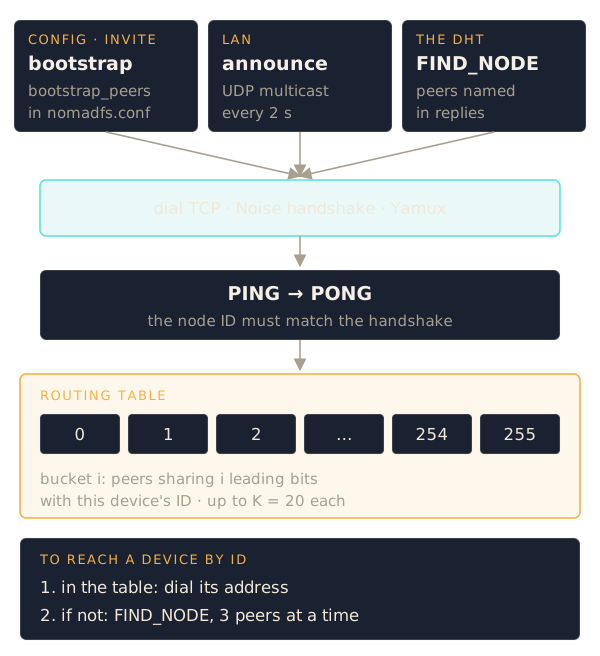
Bootstrap peers. bootstrap_peers = ["tcp://192.168.1.20:9000"] lists addresses to dial at start-up. Each one gets up to five attempts, a second apart. When you join a swarm with a one-time invite, the app adds the inviter’s address to this list, so the two devices find each other again after a restart.
LAN announcements. Every 2 seconds each node sends a small UDP datagram to the multicast group 224.0.0.251 on port 5354. It holds the node’s ID and TCP port: NMFS{"id":"…","port":9000}. A node that hears an announcement from an ID it doesn’t know dials the sender’s address on that port. The group address is the one mDNS uses, but the message is not DNS: it is NomadFS’s own announcement, on its own port. Set enable_mdns = false to turn it off.
The DHT. Peers also learn about each other from the Kademlia distributed hash table described below.
Getting through a router. With upnp_enabled = true (the default) the node asks the local router over UPnP to forward its TCP port, and removes the mapping when it stops. After it connects to a bootstrap peer, it sends a DIAL_BACK request asking that peer to connect back to it, which shows whether the port can be reached from outside.
Two kinds of ID
A device has two key pairs, so it has two IDs:
| Key | Used for | ID |
|---|---|---|
X25519 transport key (node.key) | the Noise handshake | node ID = BLAKE2s-256 of the public key |
Ed25519 identity key (device.key) | pairing, trust, revocation | device ID = BLAKE2s-256 of the public key |
The routing table is keyed by node ID. A node only adds a peer to it after a PING on a live connection, and the ID in the PONG must equal the one the handshake authenticated. A peer can’t plant a false entry by claiming someone else’s ID.
The Kademlia DHT
Kademlia arranges nodes by the XOR distance between their IDs: the distance between a and b is a XOR b, read as a 256-bit number. IDs that start with the same bits are close.
- Buckets. The routing table has 256 buckets. Bucket i holds peers whose ID shares exactly i leading bits with ours, up to K = 20 per bucket. Every bucket covers half the remaining ID space, so a node knows many peers close to it and a few far away.
- Lookup. To find a node, ask the closest peers you know for the peers they know closest to the target (
FIND_NODE). NomadFS keeps up to 3 queries in flight and repeats with the closer peers each round, until no one closer turns up. Peers named in replies are not added to the routing table until they answer aPINGthemselves. - Upkeep. After bootstrap, a node looks up its own ID once, which fills its buckets. Every 60 seconds it refreshes the buckets.
The same protocol carries provider records (ADD_PROVIDER, GET_PROVIDERS): a node can announce that it holds a file, so others can find it by content. Shares and the swarm folder don’t need this. They already know which device holds a file: the one that shares it, or the one that added it to the swarm folder.
Reaching a device
When NomadFS needs a particular device, for example to fetch a block of a share it is browsing:
- If the routing table has the device’s node ID, it dials the addresses stored there (up to 8 per peer), or reuses the open connection.
- If not, it runs a
FIND_NODElookup for that ID and then dials.
Every request after that is a message on a Yamux stream: one byte for the message type, the sender’s 32-byte node ID, then the payload. Requests include PING, FIND_NODE, GET_BLOCK, GET_SHARES, GET_SWARM, REVOKE and ROTATE_KEY.
Source: src/net/transport/tcp.zig, manager.zig, mdns.zig, nat.zig, and src/net/discovery/.