
learn · storage · 04
SHA-256 and content addressing
In NomadFS a block's name is the SHA-256 hash of its bytes. That one rule lets a device check every block a peer sends it, and store identical data once.
What SHA-256 is
SHA-256 is a cryptographic hash function from the SHA-2 family. It turns any input into a 32-byte digest. Changing one bit of the input changes about half the bits of the digest. No one knows how to find two different inputs with the same digest, or an input that produces a chosen digest. For practical purposes the digest identifies the input.
Naming blocks by their content
NomadFS stores everything as blocks: chunks of files, the blocks that link chunks into a file, and directory listings. A block’s name, its CID (content identifier), is the SHA-256 hash of the block’s bytes. Most storage names data by where it is (a path, a disk offset). Content addressing names it by what it is.
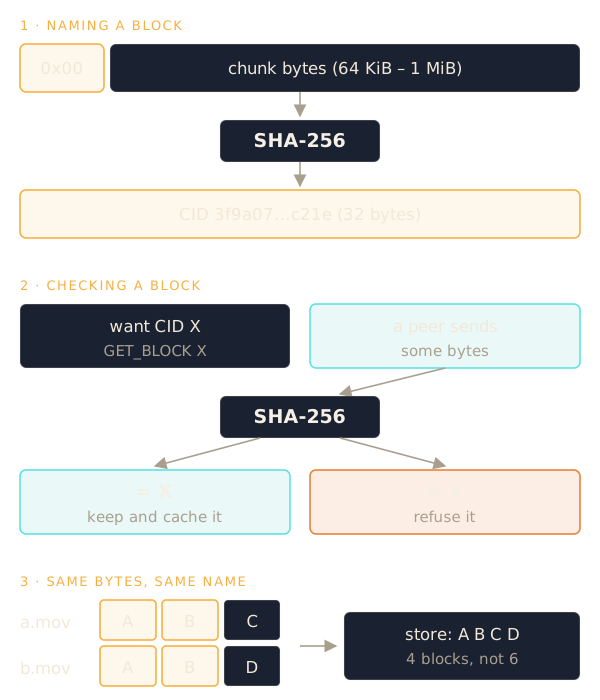
Every block starts with a one-byte tag that says what kind it is: 0x00 a leaf (raw file bytes), 0x01 a parent (links to other blocks), 0x02 a directory. The tag is covered by the hash, so a CID is the hash of the tag and the content together. A chunk’s CID is therefore not what sha256sum prints for the chunk alone. Because every block carries its tag, a block received from a peer can be decoded without any outside information.
On disk, the block store is a folder with one file per block, named by the CID in hex. A block is written to <cid>.tmp and renamed into place, so a crash never leaves a cut-off block under a valid name.
Checking every block
The name doubles as a checksum. When a device asks a peer for block X (GET_BLOCK), whatever comes back is hashed again before it is used:
- If the hash is
X, the bytes are exactly the ones that were asked for. They go into the local block store and serve as a cache from then on. - If not, the block is refused. A damaged or forged block can’t get in under someone else’s name. When reading the swarm folder NomadFS then asks the next device that might have the block.
The same check runs at other points: a block read from the local store is re-hashed, so corruption on disk shows up as an error, not as wrong data. Blocks pushed by a peer (PUT_BLOCK) are checked before they are stored. Shared files are re-hashed as they are read from the original file (see the filestore). A file that changed since its last scan reads as missing until the next scan.
This is why NomadFS can fetch a block from any device that has it, not only the one that created it. You don’t need to trust the source, because you can check the bytes.
Storing data once
Two identical chunks have the same CID. Wherever they come from, the block store keeps one copy: writing a block that already exists does nothing. Two copies of a video in the swarm folder take the space of one. A file edited in the middle shares every unchanged chunk with its earlier version, as long as chunk boundaries don’t move. Making sure they don’t is the job of FastCDC.
Names that commit to whole trees
A parent block contains its children’s CIDs, so its own CID depends on all of them. The same is true one level up. The CID at the top of a folder pins down every byte below it: if anything changes, the top CID changes. That is how a share is published: one CID per share, recomputed on each scan. Comparing two CIDs tells you whether two trees are identical, without reading them. The Merkle DAG page shows the trees.
The DHT uses hashes too, but a different one: node and device IDs are BLAKE2s-256 hashes of public keys (see TCP).
Source: src/storage/block.zig, src/storage/engine.zig, src/storage/dag/codec.zig, src/fs/remote.zig.