
learn · overview
How NomadFS works
The technologies under NomadFS, one page each: what each one is, and what NomadFS does with it.
NomadFS is built as a stack. Each layer uses the one below it and knows little about the ones above. TCP carries bytes between two devices. Noise encrypts them and proves who is on the other end. Yamux runs many conversations over that one connection. Requests travel on those conversations, and what they carry are blocks: pieces of files, named by their hash and linked into trees. Shared folders, the swarm folder and the Linux mount are built from those trees.
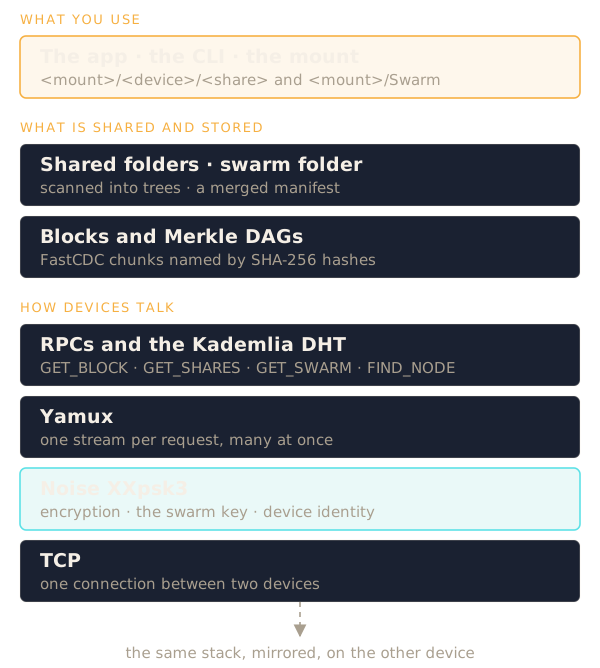
Transport: how devices talk
- TCP: finding and reaching devices. Where a device gets its peers’ addresses (configuration, invites, LAN announcements, the Kademlia DHT) and how it reaches one.
- Noise XXpsk3. The three-message handshake that encrypts every connection, checks the swarm key, and binds each device’s Ed25519 identity to the session.
- Yamux. Many independent streams over one encrypted connection, so a slow file transfer doesn’t block a directory listing.
Storage: how files become blocks
- SHA-256 and content addressing. Every block is named by its hash. That is what lets a device check every block it receives, and store identical data only once.
- FastCDC. How files are cut into chunks so that an edit changes only a chunk or two.
- Merkle DAG. How chunks are linked into file trees and directory blocks, and how a read finds the one block it needs.
Folders: what you see
- The swarm folder CRDT. The folder every device writes to, merged without a server. Concurrent edits are both kept.
- FUSE, no libfuse. The Linux mount: NomadFS speaks the kernel’s FUSE protocol itself, with no library in between.
One file, end to end
Your laptop shares Photos and your phone opens beach.jpg from it:
- The laptop scans the folder. FastCDC splits
beach.jpginto chunks, and each chunk gets a name: the SHA-256 hash of its bytes. A small parent block lists those names, and thePhotosdirectory block lists the parent. The photo’s bytes stay in the photo; NomadFS only notes where each chunk is. - The phone already knows the laptop’s address, from an invite or from the LAN. It opens a TCP connection and runs the Noise handshake. Both sides prove they hold the swarm key, and each sees the other’s device identity.
- Over a Yamux stream the phone sends
GET_SHARESand receives the root ofPhotos. On new streams it sendsGET_BLOCKfor the directory block, then for the photo’s parent block. - To show the photo, the phone asks for the chunks it covers. It hashes each one as it arrives and keeps it only if the hash matches the name it asked for. The checked chunks stay in its block store, so the photo opens again offline.
Code references on these pages point at the NomadFS source, for readers who want to check the details.